


Market updates
About $13,700 Less Buying Power and About $75 a Month: What the Oct 28 Rate Hike Means for Calgary
October 29, 2026 · Don Wong, REALTOR®, 2% Realty Inc.
Hi, I'm Don Wong, a Calgary REALTOR® with 2% Realty Inc. On Wednesday, October 28, 2026, the Bank of Canada raised its policy rate by 0.25% to 2.50%. It's the first increase since July 2023 (Bank of Canada).
Here's the short version for a typical Calgary home, before we get into the details:
- About $75 a month. On the CREB® overall benchmark home ($566,700, Sep 2026) with the minimum down, every 0.25% adds about $75 a month to a variable payment ($2,849 to $2,924).
- About $13,700 less buying power. With the same income, every 0.25% lowers what a buyer qualifies for under the stress test by about $13,700 on that same home ($566,700 to about $553,000). Put the other way, the same home now needs about $2,530 more household income.
Below I walk through what that looks like for detached homes, row homes and apartments, with 20% down and with the minimum down, for a 2021 buyer who is renewing, and for sellers pricing a home right now. I also share what my 43-year study of Calgary prices says about past hiking cycles, and I finish with the questions buyers and sellers have been asking me.
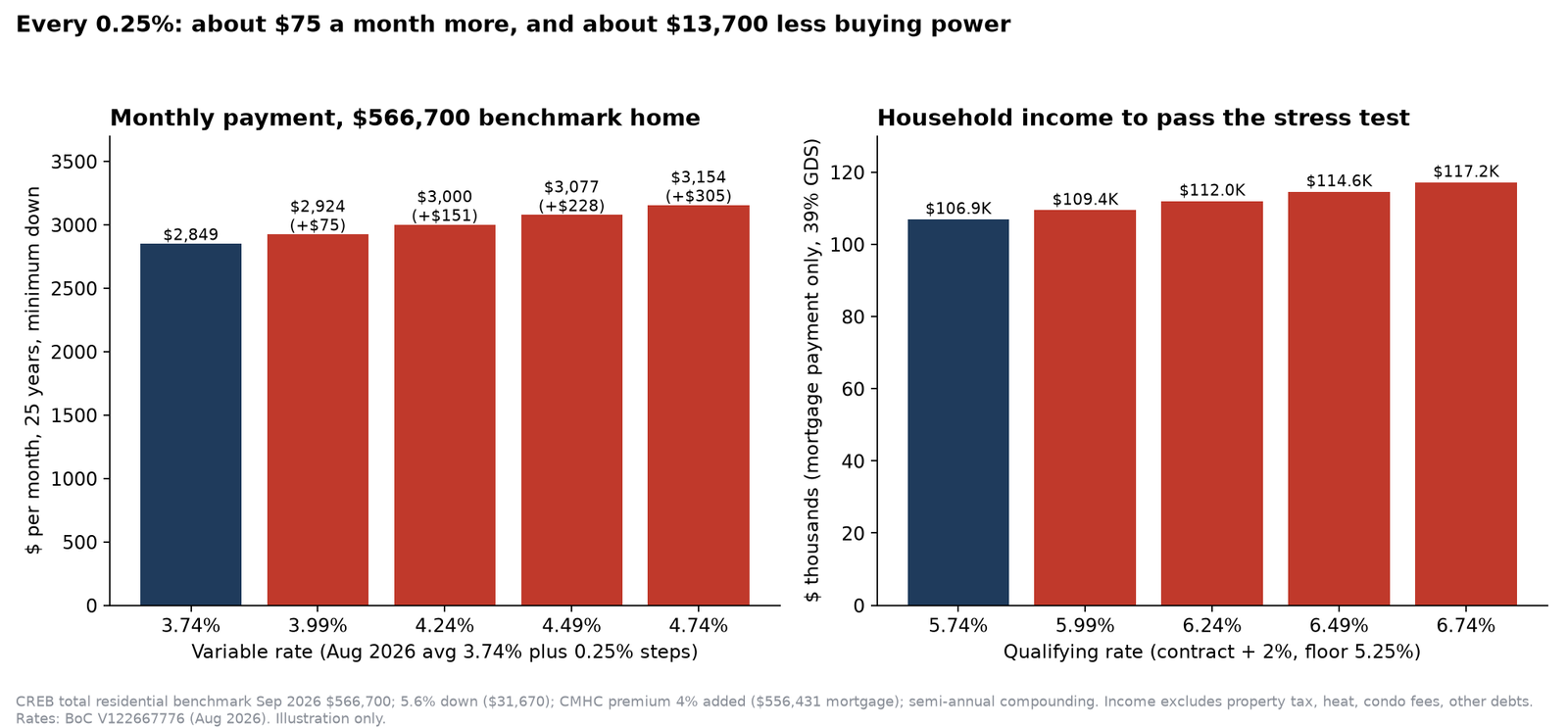
All examples in this post are illustrations, not quotes or advice. They use a 25-year amortization, Canadian semi-annual compounding, the CMHC premium added to the loan at minimum down (5% of the first $500,000 and 10% above that), and count only the mortgage payment. Property tax, heat, condo fees and other debts are left out, so real qualifying incomes will be higher. Rates come from the Bank of Canada's averages for new mortgages in August 2026 (the latest month): 3.74% insured variable and 3.90% uninsured variable, plus 0.25% for this hike.
What changed on October 28
- Policy rate: 2.25% to 2.50%. The next decision is December 9, 2026 (Bank of Canada).
- Why: the Bank pointed to inflation around 3% since April, expected to reach about 3.5% by the end of 2026, mostly from high oil prices tied to the Middle East conflict. It said there "could be a need to increase the policy rate further, but given uncertainties, Governing Council agreed to proceed carefully."
- Prime: all Big Six banks raised prime from 4.45% to 4.70%, effective October 29 (Financial Post, RBC, TD).
- Variable rates: move with prime, so they go up now. Ratehub shows advertised variable rates moving from 3.45% to 3.70% (Ratehub).
- Fixed rates: don't follow the Bank's decision directly. They follow Government of Canada bond yields, and those were already up (more on that below).
- Stress test: unchanged. Buyers still qualify at the greater of their contract rate plus 2% or 5.25% (OSFI, FCAC). Because the qualifying rate is tied to the contract rate, a 0.25% move in rates moves the qualifying rate by 0.25% too.
Example 1: what 0.25% means by home type
Here's what a 0.25% increase does to the monthly payment on each CREB® benchmark home in Calgary, at minimum down and at 20% down (CREB® Sep 2026).
| Home (CREB® benchmark, Sep 2026) | Down payment | Mortgage | Payment before | Payment after +0.25% | Change per month |
|---|---|---|---|---|---|
| Overall benchmark, $566,700 | Minimum ($31,670) | $556,431 | $2,849 | $2,924 | +$75 |
| Overall benchmark, $566,700 | 20% ($113,340) | $453,360 | $2,360 | $2,422 | +$62 |
| Detached, $739,400 | Minimum ($48,940) | $718,078 | $3,677 | $3,773 | +$97 |
| Detached, $739,400 | 20% ($147,880) | $591,520 | $3,080 | $3,160 | +$80 |
| Row, $412,400 | Minimum ($20,620) | $407,451 | $2,086 | $2,141 | +$55 |
| Row, $412,400 | 20% ($82,480) | $329,920 | $1,718 | $1,762 | +$45 |
| Apartment, $291,400 | Minimum ($14,570) | $287,903 | $1,474 | $1,513 | +$39 |
| Apartment, $291,400 | 20% ($58,280) | $233,120 | $1,214 | $1,245 | +$32 |
Minimum down uses 3.74% to 3.99% (insured variable); 20% down uses 3.90% to 4.15% (uninsured variable).
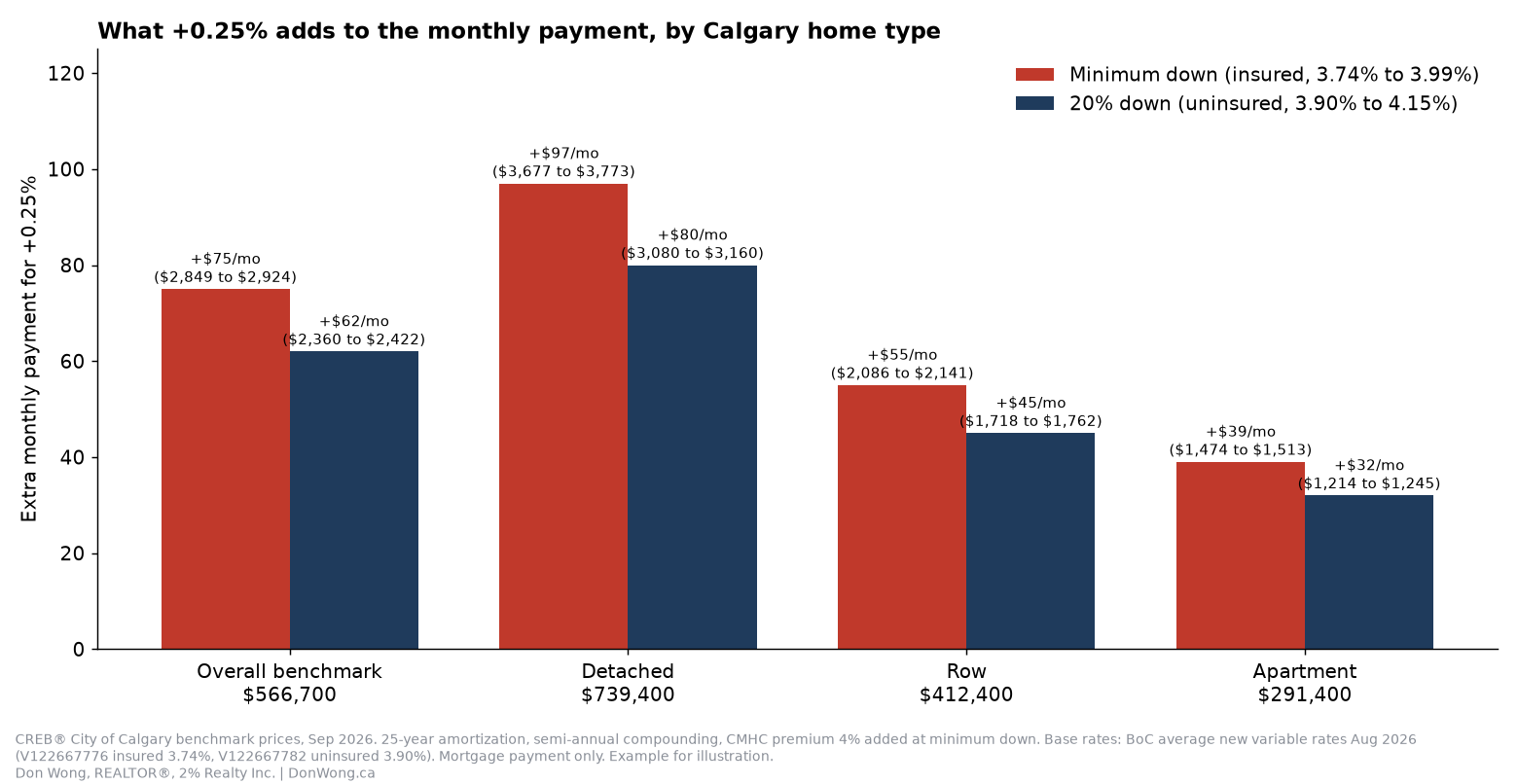
A simple rule of thumb from these numbers: each 0.25% adds roughly $13 to $14 a month for every $100,000 you borrow. That's handy when you're looking at a home that isn't at the benchmark.
Example 2: buying power per 0.25%, at 20% down and at minimum down
This is the number I think matters most for buyers. The stress test is what limits how much you can borrow, and it moved up 0.25% along with rates.
| Home | Down payment | Qualifying rate | Buying power change, same income | Extra income for the same home |
|---|---|---|---|---|
| Overall benchmark, $566,700 | Minimum | 5.74% to 5.99% | about -$13,700 (to about $553,000) | +$2,530 a year |
| Overall benchmark, $566,700 | 20% | 5.90% to 6.15% | about -$13,000 | +$2,075 a year |
| Detached, $739,400 | Minimum | 5.74% to 5.99% | about -$17,700 | +$3,265 a year |
| Detached, $739,400 | 20% | 5.90% to 6.15% | about -$17,000 | +$2,707 a year |
| Row, $412,400 | Minimum | 5.74% to 5.99% | about -$9,500 | +$1,853 a year |
| Row, $412,400 | 20% | 5.90% to 6.15% | about -$9,500 | +$1,510 a year |
| Apartment, $291,400 | Minimum | 5.74% to 5.99% | about -$6,700 | +$1,309 a year |
| Apartment, $291,400 | 20% | 5.90% to 6.15% | about -$6,700 | +$1,067 a year |
Assumes a household that just qualified for each home before the hike, at a 39% gross debt service (GDS) limit on the mortgage payment only (CMHC).
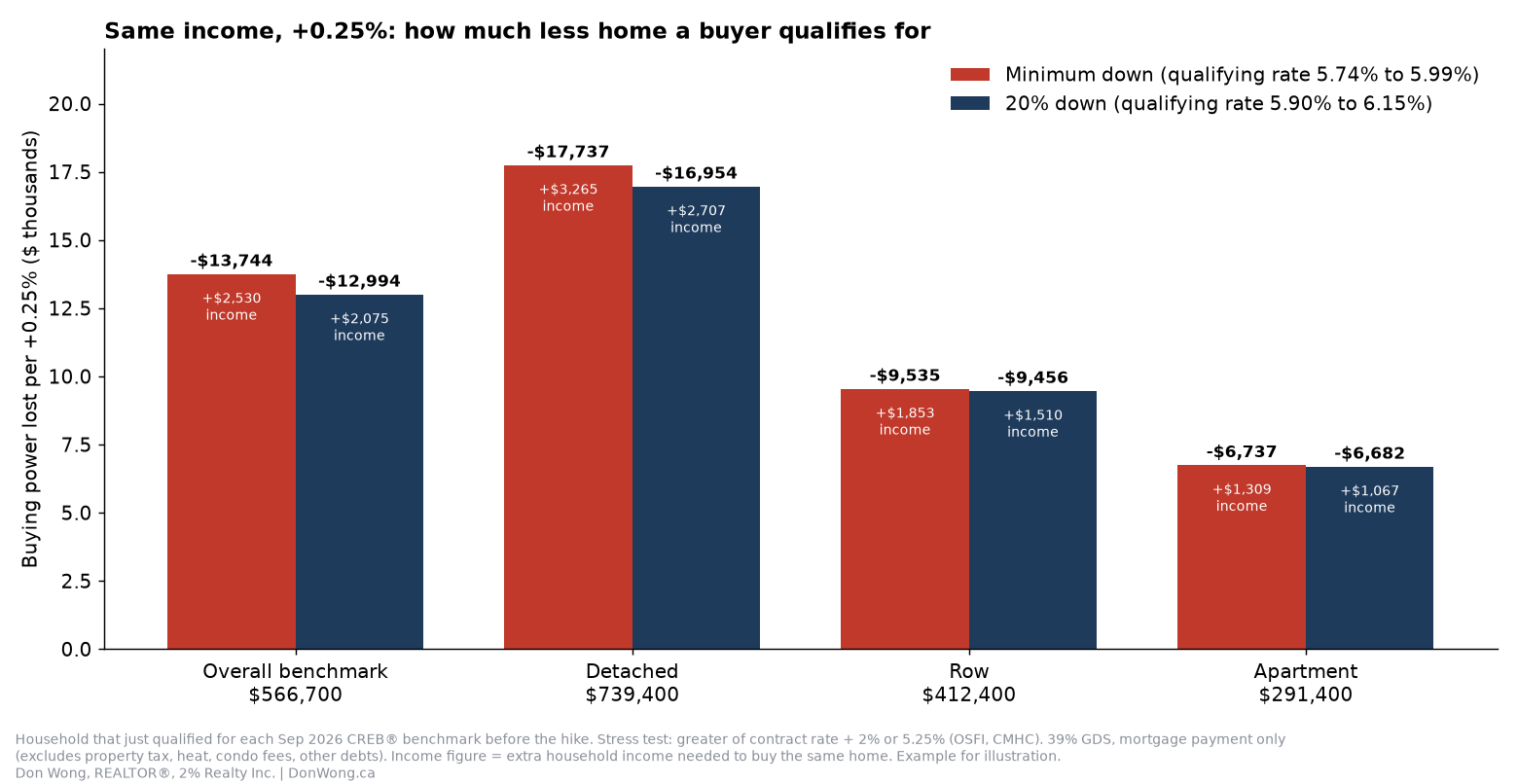
What I noticed: a bigger down payment lowers the monthly cost, but it doesn't change the percentage much. Whether you put down 5% or 20%, the same income buys about 2.3% to 2.4% less home for every 0.25%. That works out to about $2,300 less mortgage for every $100,000 you were approved for.
Example 3: a 2021 buyer renewing now
Renewals are where I think many Calgary owners will feel rates the most, and it has less to do with this one hike than with where rates were five years ago.
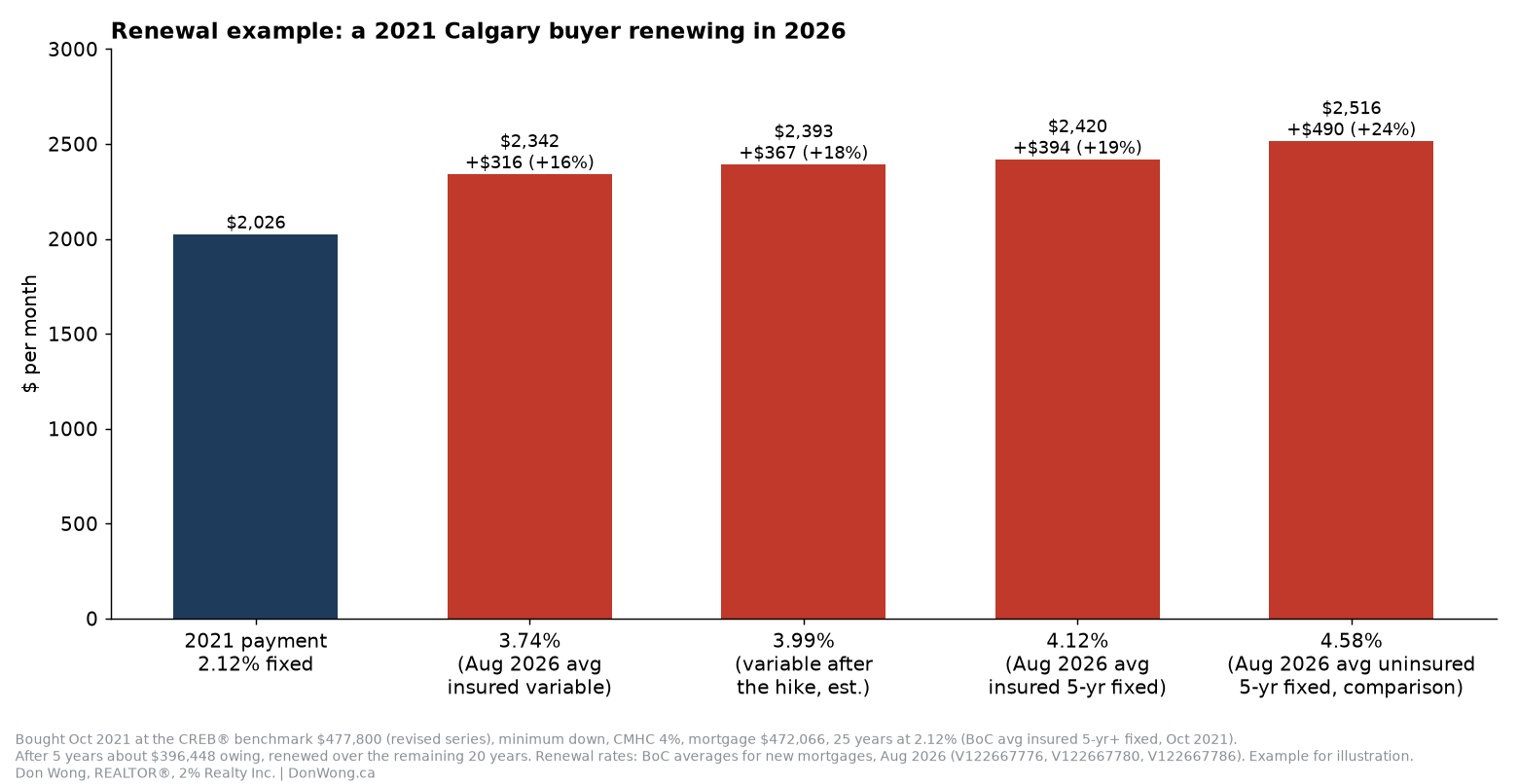
The example: a buyer in October 2021 paid the CREB® benchmark of $477,800 with the minimum down. Their mortgage, with the CMHC premium, was $472,066 on a 5-year fixed at 2.12% (the Bank of Canada's average insured 5-year-plus fixed rate that month). Payment: $2,026 a month.
Five years later about $396,448 is left with 20 years to go. Here's the payment at renewal:
| Renewal rate (BoC averages for new mortgages, Aug 2026) | New payment | Change |
|---|---|---|
| 3.74% insured variable | $2,342 | +$316 (+16%) |
| 3.99% variable after this hike (estimate) | $2,393 | +$367 (+18%) |
| 4.12% insured 5-year fixed | $2,420 | +$394 (+19%) |
| 4.58% uninsured 5-year fixed (for comparison) | $2,516 | +$490 (+24%) |
A few things worth knowing:
- This hike's share is about $52 a month on that renewal balance. Most of the jump comes from renewing off a 2.12% rate, not from the October 28 hike.
- The Bank of Canada flagged this too. Its 2026 Financial Stability Report notes that holders of 5-year-plus fixed-payment mortgages "will see large payment increases at renewal over the next 12 months" (Bank of Canada Valet, chart group FSR_2026_C8).
- Equity has grown for many 2021 buyers. The CREB® benchmark went from $477,800 (Oct 2021) to $566,700 (Sep 2026), up 18.6%. If a home tracked the benchmark, that owner would have roughly $170,000 in equity before selling costs. Every home is different, so ask me for a real number on yours.
- Options vary by lender and by mortgage type. Some owners ask about a longer amortization at renewal. For example, the same $396,448 at 4.12% over 25 years instead of 20 would be about $2,111 a month, but you pay more interest over time, and whether it's allowed depends on your lender and whether your mortgage is insured. A mortgage broker can lay out what's available to you.
For sellers: renewals are one thing I'm watching as a possible source of new listings. That's something to keep an eye on, not a prediction.
Example 4 (sellers): fewer buyers able to stretch to your price
When qualifying drops by about $13,700, it doesn't mean buyers vanish. It means some buyers who could stretch to your price before can't quite get there now.
The example: a buyer approved up to $575,000 before the hike (minimum down) now qualifies for about $561,000 with the same income. To still reach $575,000 after the hike, a buyer needed approval to about $589,000 before it. So the buyers approved somewhere between about $575,000 and $589,000 are the ones who could reach a $575,000 list price last week and can't today.
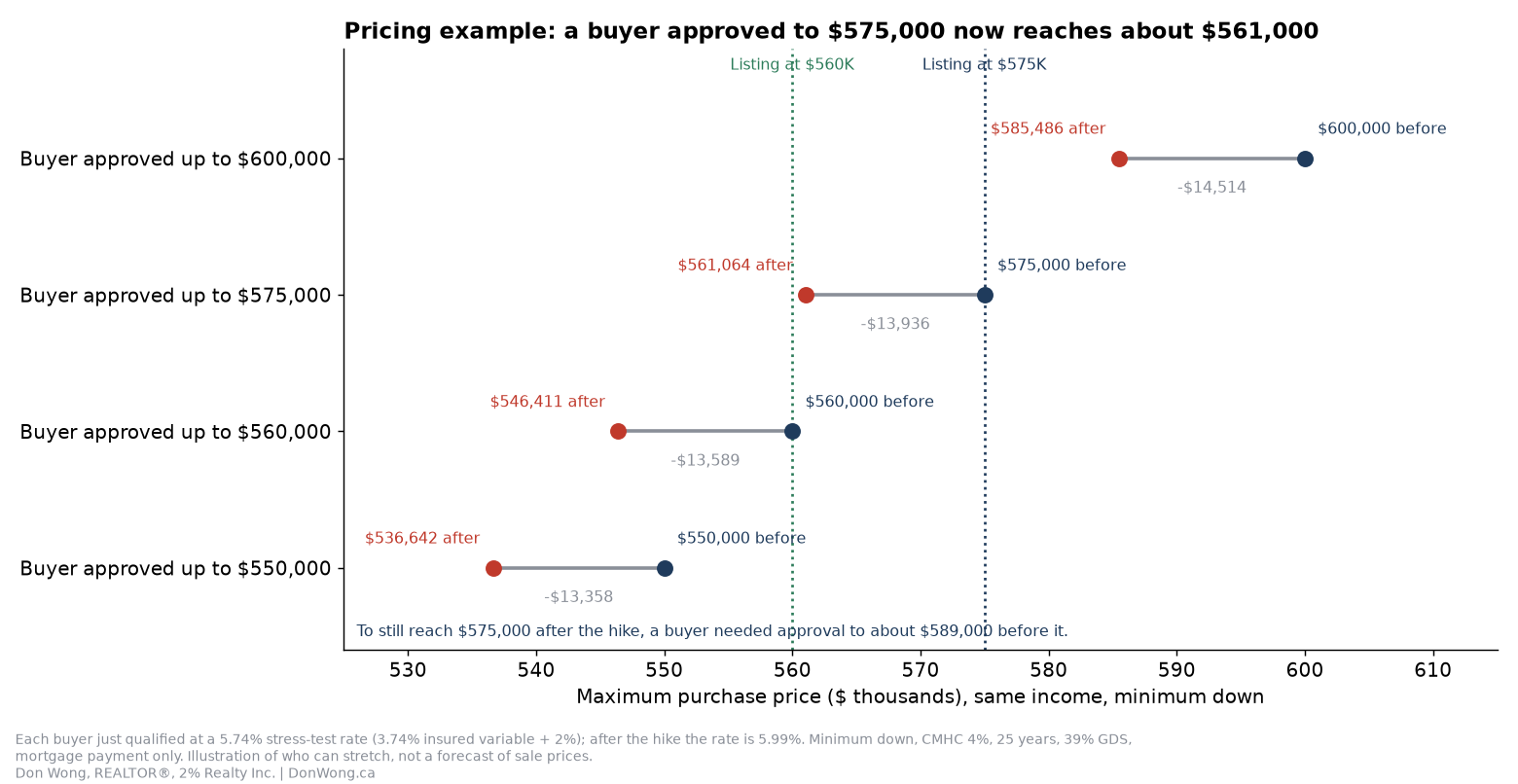
Pricing near a search threshold. Many home search sites let buyers filter by price in round steps, such as $550,000, $575,000 or $600,000. Here's how the math lines up:
- A home listed at $560,000 is still within reach of the buyer who was approved to $575,000 before the hike (they now reach about $561,000).
- A home listed at $575,000 now needs a buyer who was approved to about $589,000 before.
- That said, I can't tell you exactly how many buyers sit in that band. Nobody publishes that. What the math does show is that every price point now needs about 2.5% more buying power than it did before the hike.
I'm not saying every seller should list lower. Price depends on your home, your community and what's selling around you. The point is that where you land relative to these search steps matters a little more when qualifying gets tighter, and it's worth a conversation before you list.
Example 5 (buyers): rate holds and fixed vs variable
Rate holds. A pre-approval can lock in a rate for a set time. The Financial Consumer Agency of Canada says lenders hold rates for 60 to 130 days, depending on the lender (FCAC). Ask your lender or broker exactly how long yours is, whether it can be extended, and whether you get a lower rate if rates drop during the hold. A pre-approval is not a guarantee, so keep your documents current and avoid new debt while you shop.
Fixed vs variable right now.
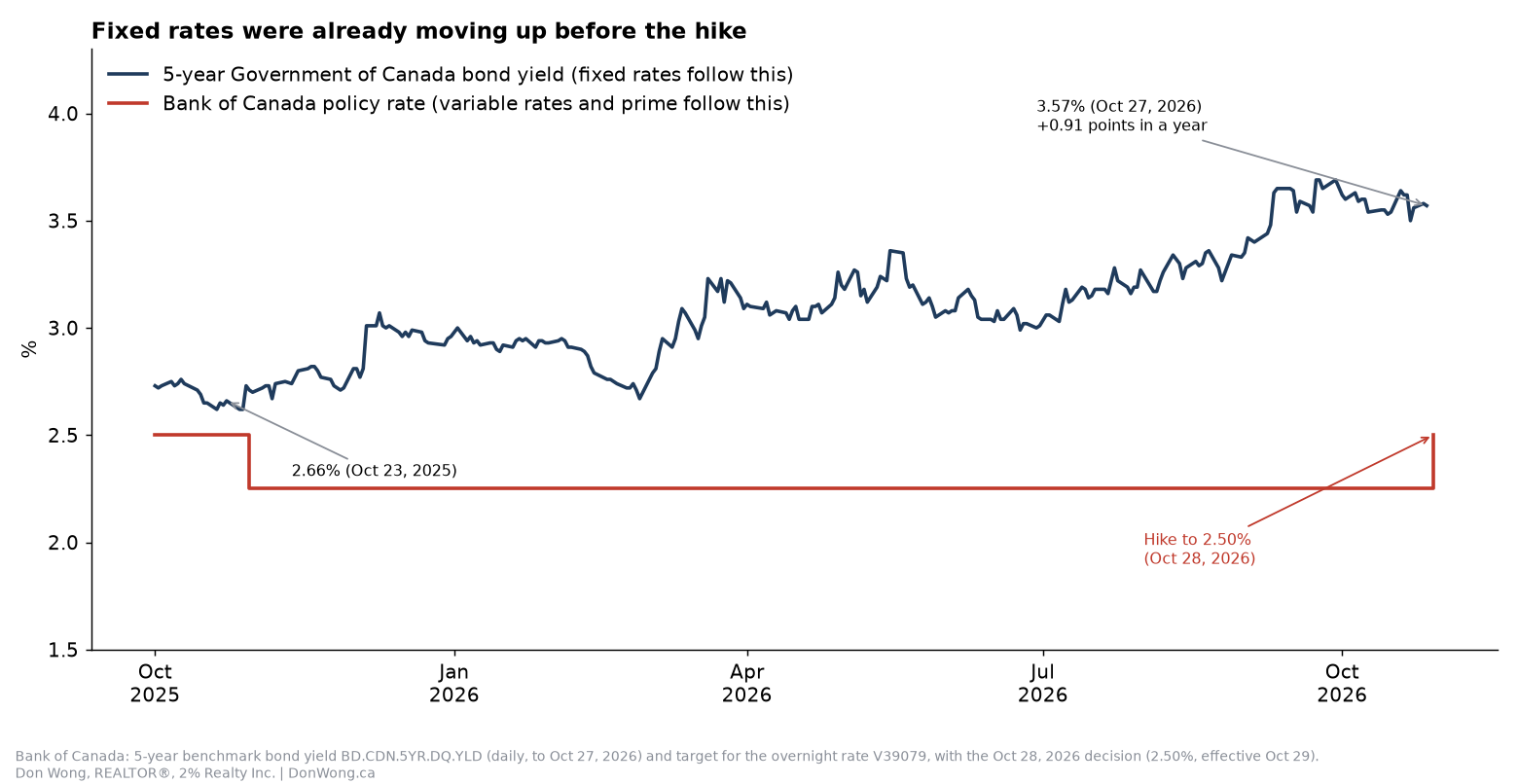
- Fixed rates follow bond yields. The 5-year Government of Canada yield went from 2.66% (Oct 23, 2025) to 3.57% (Oct 27, 2026), up 0.91 points (Bank of Canada). It averaged 3.28% in August, so it was already about 0.29 points higher by late October than in the month behind the latest fixed-rate averages.
- What borrowers actually got in August: insured 5-year fixed 4.12%, uninsured 4.58%; insured variable 3.74%, uninsured 3.90% (Bank of Canada). On October 29, Ratehub showed advertised 5-year fixed rates from 4.44% (insured) and Big Six fixed rates of about 4.69% to 5.19%.
- On the benchmark home (minimum down): a 3.99% variable is $2,924 a month; a 4.12% fixed is $2,963. That's a $39 gap using the August averages. At 4.44% fixed it's $3,061.
- The trade-off: a variable payment can move again with the next decision (the next one is December 9). A fixed rate keeps the payment steady for the term. The stress test is 2% above whichever you pick, so a fixed rate qualifies at a slightly higher rate (6.12% vs 5.99% in this example).
Which is right for you depends on your budget, how much room you have if payments rise and how long you plan to stay. That's a great conversation to have with a mortgage broker.
What history says: in my study, rates were never the whole story
In my study of Calgary prices from 1983 to 2026, I lined up the Bank of Canada's 10 hiking cycles with the Calgary New Housing Price Index (Statistics Canada, new homes, not resale).
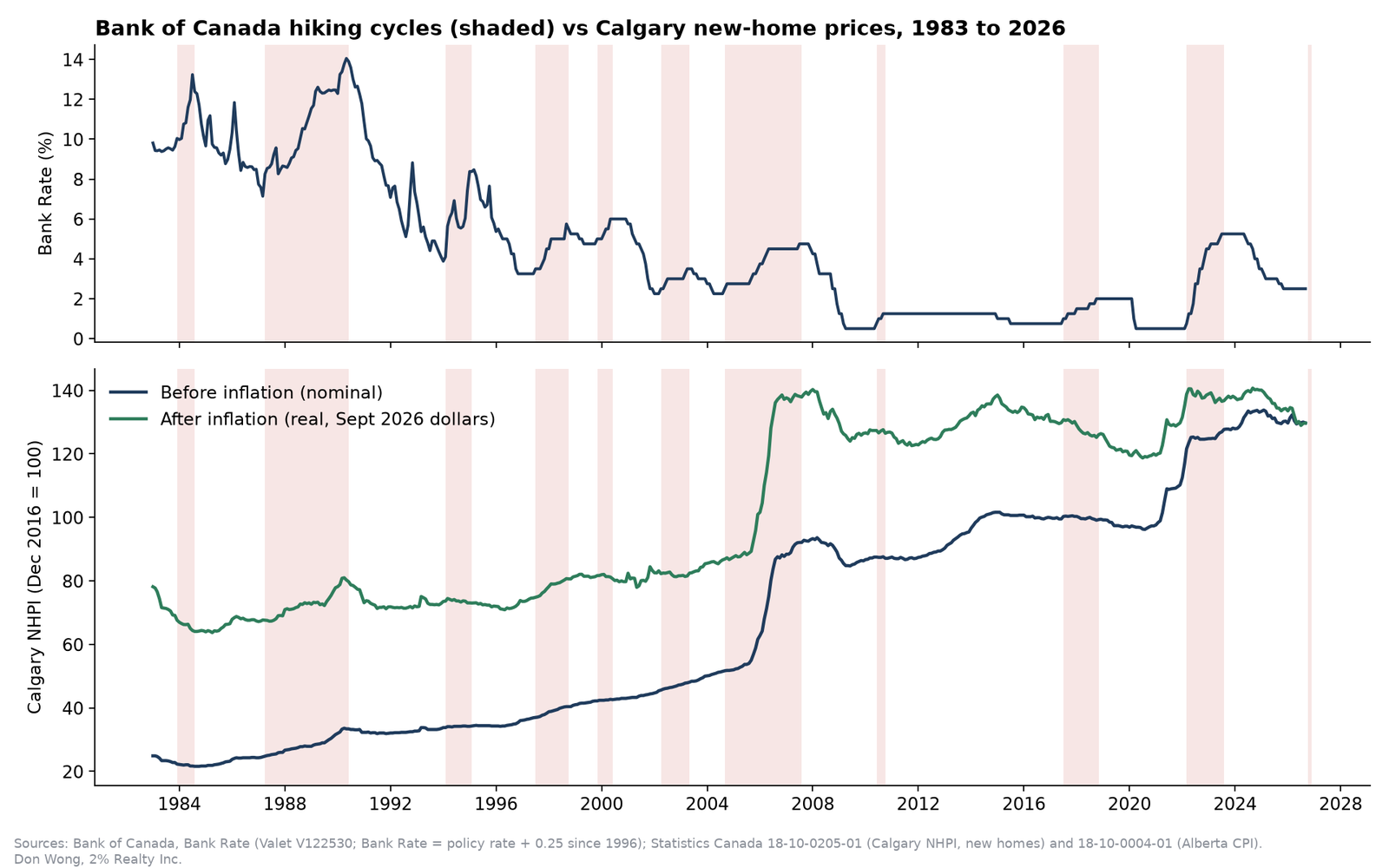
12 months after the first hike:
- Before inflation: prices were higher in 8 of 10 cycles. Median +3.4%, compared with +2.8% for any 12-month stretch since 1983.
- After inflation: prices were higher in 4 of 10 cycles. Median -1.1%, compared with +0.5% for any 12-month stretch.
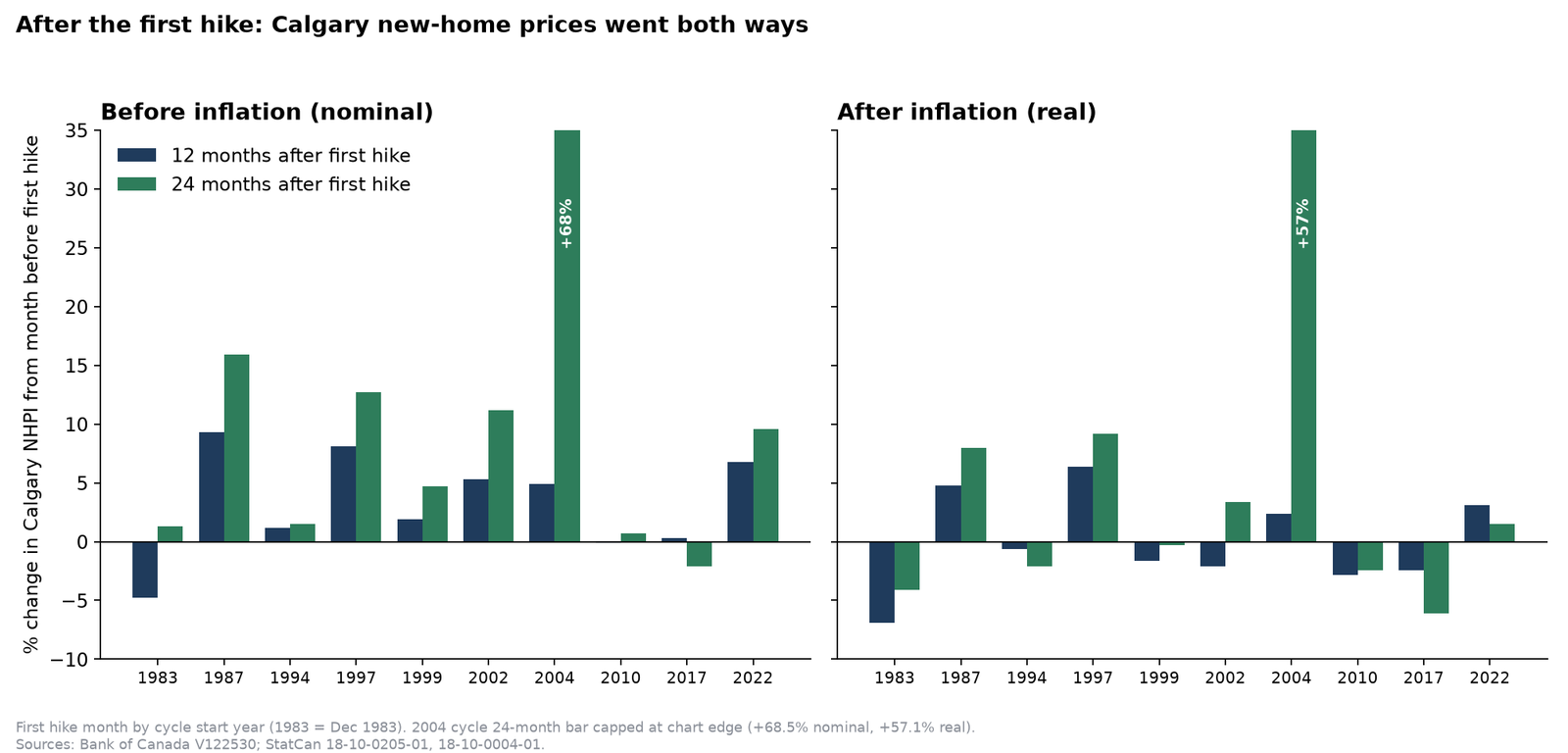
Migration mattered more than the size of the hikes. Across the 10 cycles, how much rates rose had almost no link with real prices two years later (correlation 0.03). Net migration from other provinces a year after the first hike lined up better (correlation 0.40). With only 10 cycles, none of these numbers are reliable on their own, so I treat them as a pattern worth watching, not a rule.
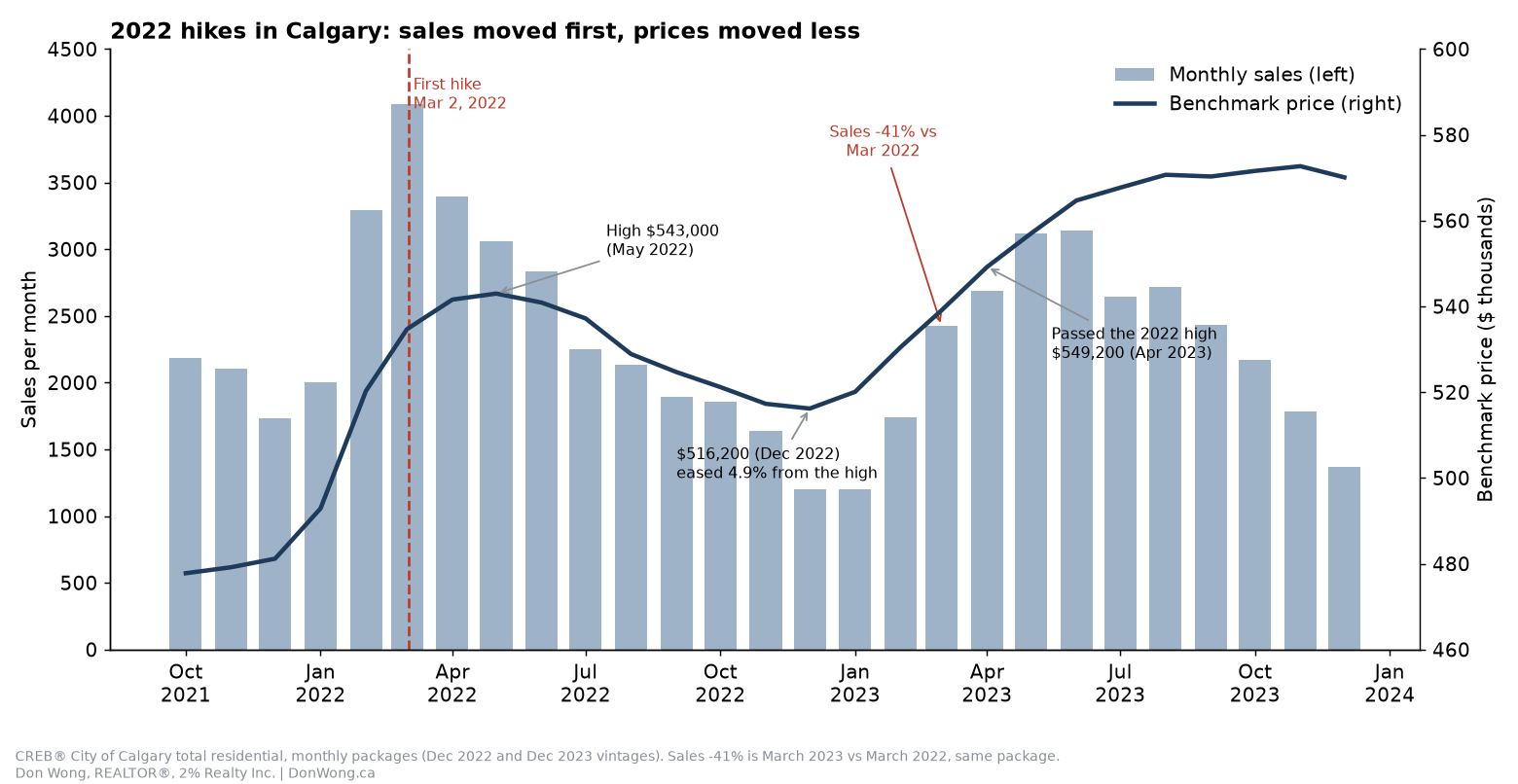
Sales moved before prices in 2022. The 2022 to 2023 hikes were the fastest in my data (+4.75 points). According to CREB®:
- Sales were still up 41% year over year the month of the first hike (March 2022). Twelve months later (March 2023) they were down 41% year over year.
- The benchmark eased 4.9%, from $543,000 (May 2022) to $516,200 (Dec 2022), then passed its old high in April 2023 at $549,200. Recovery took about 1 year.
- Inventory stayed 15% to 26% below the year before the whole time, and a record migration wave was underway. Those are big reasons prices held up.
What's different today. The migration that helped Calgary absorb 2022 and 2023 is smaller now: interprovincial arrivals were 9.3 per 1,000 people and international 29.7 per 1,000 at the end of 2023, compared with 4.3 and 7.0 per 1,000 in the latest reading (Aug 2026). Calgary new home prices (NHPI) have eased 3.1% from their February 2025 high. In September 2026, CREB® reported 1,650 sales (-3.9% year over year), 6,486 homes in inventory (-6.3%), 3.93 months of supply and 44 days on market (42 a year earlier).
My take as a REALTOR®: if you want to know how this hike is playing out in Calgary, watch monthly sales, new listings and days on market. In my study, those moved first. I'll keep sharing those numbers as CREB® releases them (October's numbers are expected in early November).
Practical checklist
If you're buying:
- Get a pre-approval now and ask how long the rate hold is.
- Ask your broker to run your numbers at your rate plus 2%. That's the number that decides your budget.
- Use the rule of thumb: about $13 to $14 a month per $100,000 borrowed for each 0.25%.
- If you were right at your limit, expect about 2.4% less room under your old maximum, or talk to your broker about options.
If you're selling:
- Look at where your price sits relative to common search steps.
- Remember a buyer approved to $575,000 before the hike now reaches about $561,000.
- Watch days on market and sales in your community, not just the rate headline.
- Ask me for a current comparable sales review before you set a price.
If you own and renew in the next year:
- Find your renewal date and current balance.
- Run your payment at today's rates (the table above is a starting point).
- Talk to a mortgage broker well ahead of your renewal date about your options.
Your questions, answered
I put myself in the shoes of a Calgary buyer, a seller and an owner who just read this and asked the questions I'd ask. Short answers, backed by the numbers above. No predictions, and for your own situation, talk to a mortgage broker.
Buyer
Should I wait for rates to come down before buying in Calgary?
Nobody can tell you when or if rates will drop, and I won't guess. What we know: each 0.25% adds about $75 a month on a $566,700 Calgary benchmark home with the minimum down, and takes about $13,700 off what the same income qualifies for. Waiting can work either way, because prices and rates don't always move together. In my study, Calgary prices after a first hike went both ways. Decide based on your budget, your timeline and a pre-approval, and talk to a mortgage broker about your numbers.
How much more do I need to earn to qualify after the October 2026 hike?
For the $566,700 CREB® benchmark home with the minimum down, about $2,530 more household income a year (about $106,900 to $109,400), counting the mortgage payment only. Detached ($739,400): about $3,265 more. Row ($412,400): about $1,853. Apartment ($291,400): about $1,309. Property tax, heat, condo fees and other debts push the real number higher, so get a pre-approval for your exact figure.
How much does 0.25% change my monthly payment?
About $13 to $14 a month for every $100,000 borrowed. With the minimum down on Calgary benchmark homes (Sep 2026): overall $566,700 +$75, detached $739,400 +$97, row $412,400 +$55, apartment $291,400 +$39. With 20% down: +$62, +$80, +$45 and +$32. Based on a 25-year amortization and the Bank of Canada's August 2026 average variable rates.
Is fixed or variable better right now?
It depends on you. Variable rates moved up with prime (4.45% to 4.70%) and can move again at the next decision on December 9, 2026. Fixed rates follow the 5-year bond yield, which was already up 0.91 points in a year (2.66% to 3.57%). Using August averages, a 3.99% variable and a 4.12% fixed on the benchmark home are $2,924 and $2,963 a month, a $39 gap. Fixed keeps your payment steady for the term; variable can go up or down. A mortgage broker can compare both for your situation.
I have a pre-approval. Does the hike change it?
If your rate is held, your held rate usually stays in place until the hold ends. The Financial Consumer Agency of Canada says lenders hold rates for 60 to 130 days depending on the lender. Ask your lender how long your hold is, whether it can be extended, and whether your approved amount changes. A pre-approval is not a guarantee of final approval.
Does putting 20% down protect me from the hike?
It lowers the dollars, not the percentage. On the $566,700 benchmark, 20% down means +$62 a month per 0.25% instead of +$75. But the same income still buys about 2.3% less home per 0.25% either way, because everyone qualifies at the stress test rate (contract rate plus 2%, or 5.25%, whichever is higher).
Seller
Will my Calgary home sell for less now?
I can't predict that, and no one can for a single home. What history shows: in my study of 10 hiking cycles since 1983, Calgary new home prices were higher 12 months after the first hike in 8 of 10 cycles before inflation and 4 of 10 after inflation. In 2022, CREB® sales fell 41% year over year within 12 months while the benchmark eased 4.9% at most, and recovery took about 1 year. Your price depends on your home, your community and current comparable sales.
Should I change how I price my home after the rate hike?
Worth a look. A buyer approved to $575,000 before the hike now qualifies for about $561,000 with the same income (minimum down). To still reach $575,000, a buyer needed approval to about $589,000 before. So fewer buyers can stretch to each price point. Many search sites filter by round price steps, so where you land relative to them matters a little more. This is not a forecast; it's a reason to review your pricing with your REALTOR®.
Should I sell before rates go up again?
The Bank of Canada said there could be a need to raise rates further but that it will proceed carefully, and I don't make rate or price predictions. Sell when it fits your plans. Practically, watch monthly sales, new listings and days on market in your community. In my study those moved first. In September 2026, CREB® reported 44 days on market, compared with 42 a year earlier.
Will more homes come on the market because of renewals?
Possibly, and it's something I'm watching, not predicting. The Bank of Canada's 2026 Financial Stability Report says holders of 5-year-plus fixed mortgages will see large payment increases at renewal over the next 12 months. In my example, a 2021 Calgary buyer's payment goes from $2,026 to about $2,420 (+19%) renewing at 4.12%. In September 2026, CREB® inventory was 6,486, down 6.3% from a year earlier.
Owner
I renew next year. What should I do?
Start early. Find your balance and renewal date, then run your payment at today's rates. Example: a 2021 buyer with about $396,448 left and 20 years to go pays $2,026 at 2.12% and about $2,393 to $2,420 at 3.99% to 4.12%, about $367 to $394 more a month. This hike's share is about $52 of that. Many 2021 buyers also have more equity now (the CREB® benchmark rose 18.6% from Oct 2021 to Sep 2026). Talk to a mortgage broker about your options before your lender's renewal offer arrives.
Did Calgary prices drop the last time rates went up?
Sometimes. During the 2022 hikes, the fastest in my data, the CREB® benchmark eased 4.9% from $543,000 to $516,200 and passed its old high in April 2023, so recovery took about 1 year. In my study, migration lined up with prices better than the size of the hikes (correlation 0.40 vs 0.03), but with only 10 cycles that's a pattern, not a rule. Migration is lower today, and Calgary new home prices have eased 3.1% from their February 2025 high.
Sources
- Bank of Canada, interest rate announcement, Oct 28, 2026: https://www.bankofcanada.ca/2026/10/fad-press-release-2026-10-28/
- Bank of Canada, Governor's opening statement (as reprinted by investingLive): https://investinglive.com/central-banks/the-full-statement-from-the-bank-of-canada-rate-decision-for-october-2026-hikes-by-25-basis-points/
- Bank of Canada, policy rate page: https://www.bankofcanada.ca/core-functions/monetary-policy/key-interest-rate/
- Bank of Canada, 5-year benchmark bond yield (BD.CDN.5YR.DQ.YLD): https://www.bankofcanada.ca/rates/interest-rates/canadian-bonds/
- Bank of Canada, average rates on new mortgages (A4_RATES_MORTGAGES, series V122667776, V122667780, V122667782, V122667786): https://www.bankofcanada.ca/valet/observations/group/A4_RATES_MORTGAGES/json
- Bank of Canada, Bank Rate (V122530): https://www.bankofcanada.ca/valet/observations/V122530/json
- Bank of Canada, Financial Stability Report 2026, chart 8 (Valet group FSR_2026_C8): https://www.bankofcanada.ca/valet/lists/groups/json
- Prime rate changes: RBC https://www.newswire.ca/news-releases/rbc-royal-bank-announces-change-to-prime-rate-837555648.html ; TD https://td.mediaroom.com/2026-10-28-TD-Canada-Trust-announces-change-to-TD-Prime-Rate ; Financial Post https://financialpost.com/fp-finance/banking/banks-raise-prime-rate-after-bank-of-canada-interest-rate-increase ; Canadian Mortgage Trends https://www.canadianmortgagetrends.com/mortgage-wire/2026/10/28/big-banks-raise-prime-rates-to-4-70-following-boc-hike/
- Ratehub, advertised mortgage rates, Oct 29, 2026: https://www.ratehub.ca/best-mortgage-rates/5-year/fixed
- OSFI, minimum qualifying rate: https://www.osfi-bsif.gc.ca/en/supervision/financial-institutions/banks/minimum-qualifying-rate-uninsured-mortgages
- FCAC, preparing for a mortgage: https://www.canada.ca/en/financial-consumer-agency/services/mortgages/preparing-mortgage.html
- FCAC, getting preapproved (rate holds of 60 to 130 days): https://www.canada.ca/en/financial-consumer-agency/services/mortgages/preapproval-qualify-mortgage.html
- CMHC, GDS and TDS: https://www.cmhc-schl.gc.ca/professionals/project-funding-and-mortgage-financing/mortgage-loan-insurance/calculating-gds-tds
- Insurable Housing Loan Regulations: https://lois-laws.justice.gc.ca/eng/regulations/SOR-2012-282/FullText.html
- CREB®, City of Calgary monthly statistics, Sep 2026: https://www.creb.com/Housing_Statistics/documents/09_2026_Calgary_Monthly_Stats_Package.pdf ; Dec 2022 and Dec 2023 packages via https://www.creb.com/Housing_Statistics/
- Statistics Canada, New Housing Price Index, Calgary (18-10-0205-01): https://www150.statcan.gc.ca/t1/tbl1/en/tv.action?pid=1810020501
- Statistics Canada, Consumer Price Index, Alberta (18-10-0004-01): https://www150.statcan.gc.ca/t1/tbl1/en/tv.action?pid=1810000401
- Statistics Canada, migration estimates (17-10-0020-01, 17-10-0040-01): https://www150.statcan.gc.ca/t1/tbl1/en/tv.action?pid=1710004001
This post is general information, not financial, legal or mortgage advice. Examples are illustrations using the stated assumptions. Past results don't tell us what will happen next. Talk to a licensed mortgage professional about your situation.
Don Wong, REALTOR®, 2% Realty Inc.
Visit DonWong.ca and learn how Calgarians are saving thousands today.